Wednesday, May 7, 2014

From the Orange River

Cycling through the southern Namibian landscape was surreal. This is so sparsely populated that any sign of human life is rare. The dominant terrain is scrub, tumbleweed, and fragile wisps of grass. Our last few campsites were at an old converted railway hotel, replete with taxidermist, in Seeheim and a classic roadhouse near the Fish River canyon. The latter joint had the most impressive collection of licence plates and road signs this side of Nevada.

Our last rest day was spent in a riverside location called Felix Unite. Road-weary and exhausted from the dirt roads, most TDA participants opted to watch the river flow. On the far side of the Orange, the Republic of South Africa has a similar arid look.


The river forms the border separating Namibia, once administered by South Africa, from the republic where we now find ourselves. From the immigration checkpoint, we climbed into a barren, desolate landscape and then faced a stiff headwind. The lunch truck was full that day as the raging gusts can sap the energy from one's legs over hours of hard pulling. Our destination that day was an unassuming caravan park near Springbok. The dark clouds loomed and the temperature plummeted. Thermal wear emerged from the lockers and riders retired early to assume the fetal position.

This region of South Africa, the northern cape, is characterized by vast, barren tracts of marginal land. Rugged farmers manage to eke out a living from grazing their livestock on massive tracts. We rode a few tough days to camps in Kliprand and Nieuwoudtville. In each remote village, signs of the upcoming election were evident.


Since Mandela, the ANC has ruled the roost. The incumbent, Jacob Zuma, is expected to be returned to power despite allegations of corruption, self-indulgence and incompetence. Tonight, I intend to watch the results on local telly as the pundits spew forth their analyses regarding the people's decision.  At first glance, one can see the tremendous wealth here and the vestiges of apartheid which play out in  massive income inequality. A positive trend appears to be the sense of empowerment on the part of "ordinary" Africans who will, in time, realize their potential in terms of the destiny of thus complex nation.


As the tabloid press announced yesterday, it is up to you. Mandela's legacy is evident notwithstanding the contradictions, the de facto segregation and the transparent gap between people of different races or colours. 


Thursday, May 1, 2014

Sand Sea

The last section puts us on a road of sand and, sometimes, corrugation with rock. The latter track can be taxing on those without suspension and/or fat tires. If desert landscape inspires you, this is your paradise. Vegetation is sparse and whatever grows is thorny.


On our last rest day, Steven, drove the staff and some stragglers to dune 45, an iconic formation out on Sossuvlei. A group of us hopped on the lunch truck at sunset and headed for deep sand.


Here is the place where we could have climbed the ridge. 


Instead, we rolled further west in a vain attempt to catch the sunset. When we arrived at the vantage point, we got the following view. By the length of the shadows, one can see that the sun is fading quickly.


The story of sand is fascinating and the Namibian government, to its credit, has preserved much of this unique, precious landscape. Equally important, the wildlife are protected and the safari industry is primarily for photographers not hunters. Curiously, one of our campsites here was abandoned by the Namibian manager and it was occupied by Afrikaners who had driven up to hunt for game such as oryx.


Friday, April 25, 2014

Solitaire to Sossusvlei


The end of the tour is nigh. We left Windhoek and pavement yesterday to camp at a site which doubles as a spiritual retreat and a stud farm. It was stark, isolated and lonely. Today, we continued on the dirt: in turns, hard-packed and sandy. This surface is a boon to off-road cyclists. Indeed, it is their preference. It is fitting that our Aussie friend Helen embarked on the Jo'burg to Sea mountain bike venture as we roll south to the Namibia desert, after which this spacious country is named. 

If you have been following this commentary, you may notice gaps in posts. This is due to the inconsistent internet access throughout the continent. Each country has a different protocol and the riders with smart phones urgently acquire SIM cards upon arrival in a new jurisdiction. Given my IPad, I wait for wifi which is hit or miss, mostly miss on the long stretches of road in isolated regions. Here we are in the aptly titled hamlet of Solitaire.


The community consists of a petrol station, a bakery renowned for apple pie and a general dealer. The population is listed on the sign. One may conclude that all of them work here.


This last section culminates with the convoy into Cape Town. There is a lot of dirt to cover. Our road int town was marked by an epic descent that was thrilling. It gave way to piste that drew us to our camp. 


Tomorrow is the final time trial and rider meeting beckons. Our destination is Sesriem which exits as a transit point and accommodation venue for those who wish to take in the famous dunes at Sossusvlei. The TDA has awarded us a day of rest in this village in order to appreciate the red sand.


One last note regards the water management of this region. The basin is vulnerable to drought so the precious resource, the gold of this century, must be wisely managed. Take a look at this sign.


Windhoek

This day of leisure has afforded us access to western luxuries as the capital of Namibia has almost everything one needs in terms of amenities. Windhoek is set among the hills and has broad boulevards that cross the town. These roads, like many in African capitals, bear the names of their heroes. If your name is equated with the independence struggle, there is a street bearing your name. It matters not whether you have fallen into disrepute.


The affluence of the city is apparent with the well-appointed suburban communities such as the one where we have made our camp. It is within walking distance of malls that resemble what westerners are accustomed to at home.


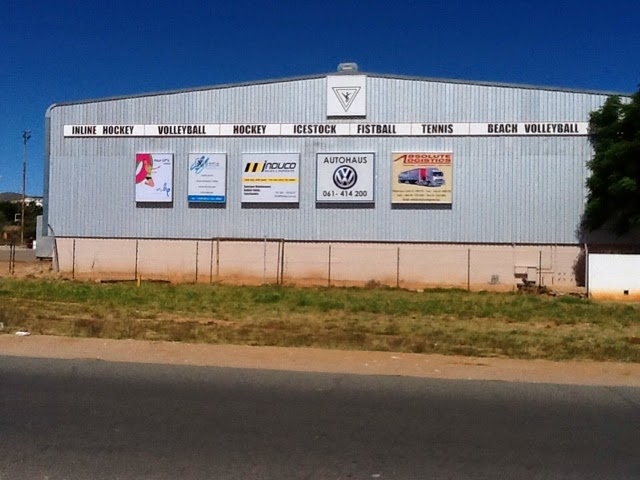
Another reminder of the wealth here is the presence of sporting facilities. As I cycled into the city to run errands, there was a complex that offered many activities that I associate with my native land, Canada.


And, of course, what German city would be without a good brew. We celebrated at Joe's beer house with several pints of the local draught. 


Namibia Burn

Our cook, Yanez, is familiar with the Burning Man phenomenon. Indeed, there is one in South Africa that has a similar ethos to the Nevada tradition. The other night, a mini-burn was organized after dinner with our leader, Randy, playing percussion and our driver Noah encouraging folks to dance and send messages on paper into the fire. 


Everyone took part and the pyrotechnics were impressive for so,etching that was hastily brought together using local wood and kindling. 


Heads, Tails and the Trans-Kalahari

The road from Maun to Windhoek is more or less flat and straight. The scenery is scrubby and ordinary. It challenges one's imagination as the distances are daunting. In fact, we had six centuries during this past section. Unless you listen to tunes or podcasts, there is ample time for reflection. It helps to avoid thoughts of aching quadriceps and hamstrings. 

One diversion is the ubiquitous presence of a bug on the highway. It may indeed be a cricket. Whatever species it is, the insect moves slowly and is vulnerable to being crushed. When the tire runs over it, the guts, a yellowish colour, spray on one's legs. This irksome insect also inhabits our campsites, sometimes joining us in our tents.


The elephant highway section finished yesterday with a stiff headwind as we pulled into the Namibian capital of Windhoek, a modern city surrounded by some low-lying hills which we climbed from the east. Headwinds have been a recurring source of lament during this year's TDA. We struggled north of Khartoum and the trend has been for any wind to be in our face rather than at our back. The one notable and fortuitous exception was the epic 200 km. plus day when we copped a tail wind in western Botswana that was a blessing.

The campsites have been off the road in the "bush". We set up our tents and cots among acacia trees. Thorns are a nuisance to both the body and the bicycle. The vegetation in the deserts is prickly indeed.

Sunday, April 20, 2014

Special Dutch

The latest section of the tour commenced on a foggy morning in Livingstone, Zambia. Nine new riders joined the escapade. Five of them are from the Netherlands, including one rider, Paul, who did the opening Sudanese section with us. Paul is an experienced TDA rider. He taught me a lot about simple approaches to gearing and to taking a wide path going up hills. Collectively, the Dutch are remarkable cyclists.

The other day, there was a team time trial on the flats of Botswana. Guess who won it? Yes, the Dutch rocked the fastest time. It was but a foregone conclusion. Another team comprised of folks from northern climates was led by a Dane, Klaus, who is back for his third TDA after breaking his leg one year and his pelvis another year. He is an exceptionally strong cyclist and obviously intrepid.


This was at the end of the time trial, bikes strewn around the lunch truck. Food!

Yesterday was the longest day of the tour. Almost all of us endured 208 kilometres across flat Botswanan terrain to the Nambian border. A new woman's record was set for this leg of the trip. Ina, a remarkably fit rider from the Netherlands, smashed the record (as she would say "with a little help from my friends"). She is a delightful person who has dominated the woman's field this year. Here she is relaxing after the victorious time trial. Well done Ina!